
KNIGHTS VALLEY AVA
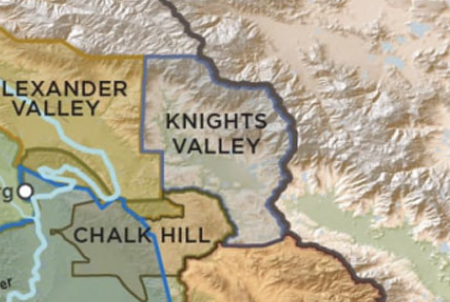
Knights Valley occupies the northeastern corner of Sonoma County, bordering Napa's Calistoga AVA and tucked between the Mayacamas and the lower flanks of Mount St. Helena. The Bureau of Alcohol, Tobacco and Firearms approved the AVA on October 21, 1983, after a petition by the Knights Valley Wine Growers Committee that included R.L. Maher, Robert Steinhauer, and winemaker Myron Nightingale of Beringer Vineyards. The valley takes its name from Thomas B. Knight, who settled in the area in the mid-nineteenth century and saw the first commercial vineyards planted in the 1860s and 1870s.
The geography is intimate and somewhat enclosed. The AVA covers roughly 39,000 acres but contains only about 2,000 acres of vines, with elevations ranging from valley-floor heights around 400 feet up to about 2,000 feet on the lower slopes of Mount St. Helena, an extinct volcano whose 4,342-foot peak dominates the eastern skyline. Soils are largely volcanic in origin, mixing rocky alluvial deposits on the valley floor with steeper, more rugged volcanic ash and clay on the hillsides. Drainage is excellent throughout, and the surrounding mountain walls protect the vineyards from the cool Pacific air that reaches the rest of Sonoma County.
Climate gives Knights Valley its identity. According to the original 1983 ATF petition cited by Wikipedia and confirmed by Sonoma County Winegrowers, Knights Valley has the warmest climate in Sonoma County. The Coastal Ranges and Mayacamas effectively block marine influence from the west, while the valley sits too far north to catch the bay air that cools Carneros and southern Sonoma. Daytime summer temperatures regularly reach the high nineties, and the diurnal swing is moderated more by elevation than by fog. The result is Cabernet Sauvignon of exceptional ripeness and structure, accounting for roughly two-thirds of the appellation's plantings, alongside Merlot, Cabernet Franc, Malbec, Petit Verdot, Syrah, Zinfandel, and small amounts of Chardonnay, Sauvignon Blanc, and Sémillon. The wines tend to show ripe black-fruit concentration, chocolatey richness, firm tannins, and serious aging potential.
Beringer Vineyards has farmed Knights Valley since the mid-1960s and was instrumental in establishing the AVA; the "Knights Valley" designation appeared on Beringer labels as early as 1974. Peter Michael Winery, founded by British industrialist Sir Peter Michael in 1982, occupies a stunning mountainside estate on the western slope of Mount St. Helena, with vineyards planted at elevations up to about 2,000 feet. The flagship Les Pavots Bordeaux blend and a celebrated lineup of single-vineyard Chardonnays have made Peter Michael one of California's most acclaimed producers. Knights Bridge Winery, founded in 2006, and Morlet Family Vineyards, established by former Peter Michael winemaker Luc Morlet in 2008, are notable newer additions.
For buyers, Knights Valley offers one of the last quiet corners of premium Sonoma wine country, with large estate parcels, dramatic mountain views, and direct access to both Calistoga and Healdsburg within twenty minutes.
