
CHILES AVE AVA
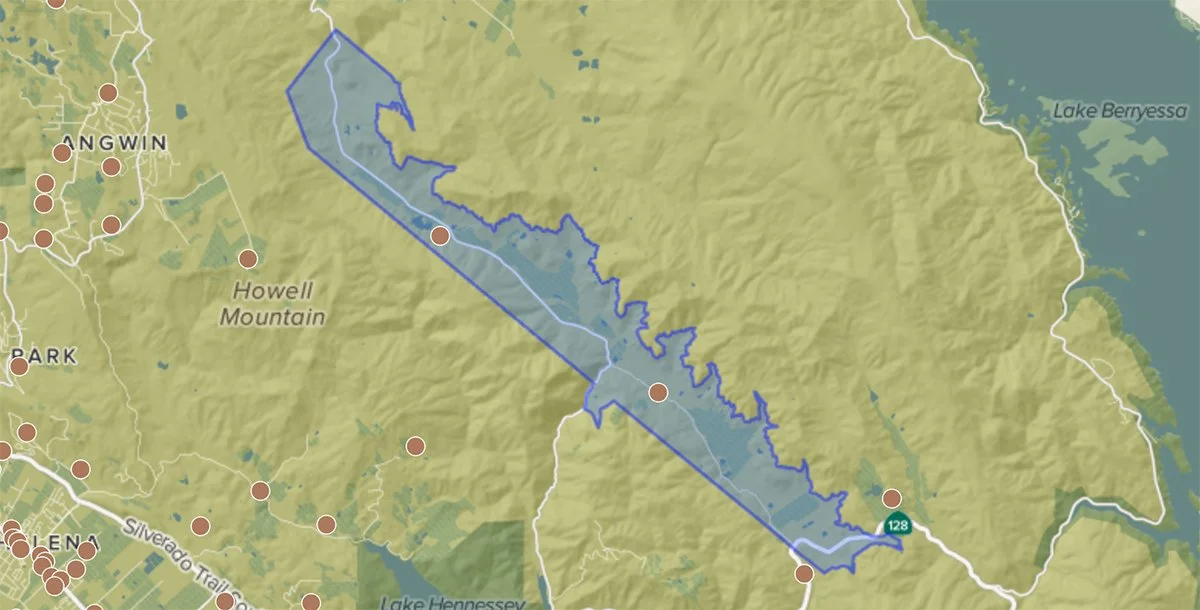
Tucked into the eastern folds of the Vaca Mountains, the Chiles Valley AVA is one of Napa Valley's quietest and most idiosyncratic addresses. The Bureau of Alcohol, Tobacco and Firearms approved it on April 19, 1999, after a petition led by the late Volker Eisele, the longtime grower-philosopher who farmed Rancho Catacula. The valley itself takes its name from Joseph Ballinger Chiles, a Kentucky-born pioneer who received the Mexican land grant in 1844 and planted the area's first vines around 1850. Phylloxera largely passed it by thanks to sheer geographic isolation, and a handful of pre-phylloxera Zinfandel vines still produce fruit today.
Geography sets the tone for everything else. Chiles Valley is a long, narrow trough running northwest to southeast at roughly 600 to 1,200 feet of elevation, completely ringed by hills that rise to 2,200 feet. Soils are predominantly volcanic in origin, with clay loam on the valley floor and stonier, weathered material on the hillsides. Free drainage and modest fertility encourage deep root systems, while the surrounding ridgelines funnel afternoon winds from the Pacific down across the vineyards. Days are sunny, nights cool sharply, and the resulting diurnal swing rivals anything on the Napa floor below.
Climate here is best described as warm-mountain rather than valley-warm. Because Chiles Valley sits east of the main valley and well above the bench, marine fog arrives later in summer than it does over Rutherford or St. Helena, but elevation pulls nighttime temperatures down quickly. The growing season is long, ripening unhurried, and acidity holds longer than valley-floor sites tend to allow. Old-vine Zinfandel responds beautifully, producing wines of dense red and black fruit with cinnamon and pepper spice. Cabernet Sauvignon grown here tends to show more finesse and earthy lift than its more famous siblings down on the bench, while smaller plantings of Cabernet Franc, Sauvignon Blanc, and Chardonnay round out the picture.
Notable and historic producers anchor the appellation's identity. Volker Eisele Family Estate, the original AVA petitioner, has been farming organically here since the mid-1970s. Brown Estate, the first Black-owned winery in Napa Valley, is famed for its Chiles Valley Zinfandel. Nichelini Family Winery, founded in 1890 and still operating on the family's original site, is one of Napa's oldest continuously operating producers. RustRidge Ranch and Winery, established by the Meyer family in 1985 on former thoroughbred land, and Maxville Estate in the upper valley round out a small but distinctive roster.
For buyers and visitors, Chiles Valley offers a version of Napa that the valley floor lost long ago. Estates here tend to be working ranches as much as wineries, with cattle, orchards, and old barns sharing the road with vineyard rows. Land trades far less frequently than down on Highway 29, and pricing reflects that quieter reality. For those who want privacy, elevation, and a slower rhythm without giving up a Napa Valley address, this is one of the last places to find it.
