
DIAMOND MOUNTAIN DISTRICT AVA
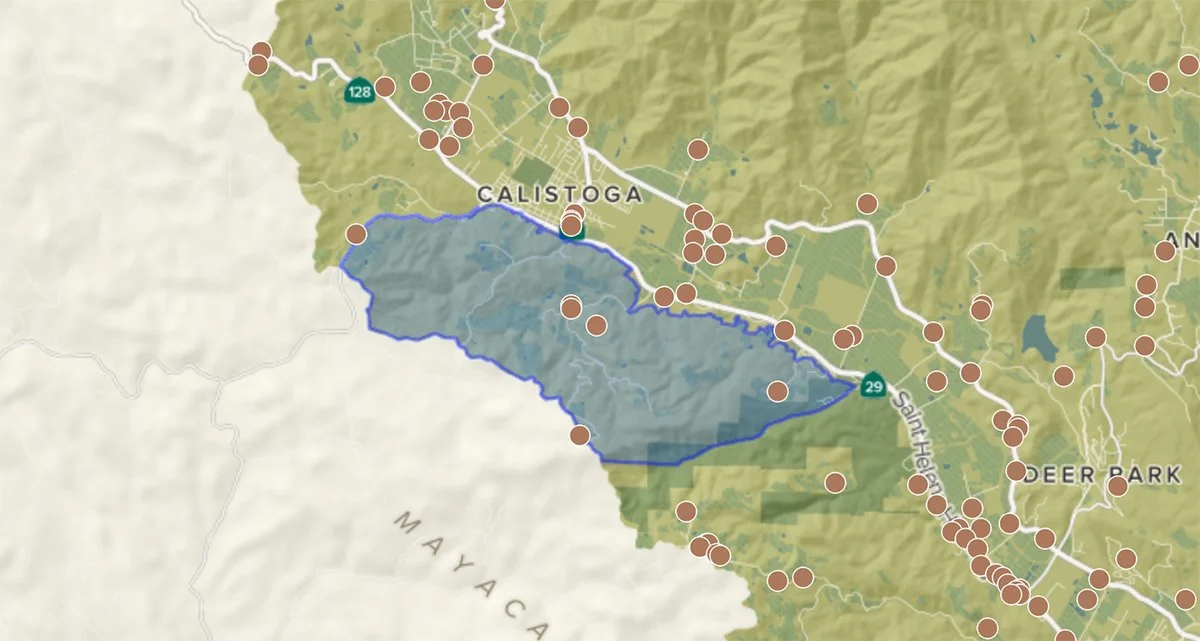
High above Calistoga on the northwestern shoulder of the Mayacamas Range, the Diamond Mountain District AVA was approved in 2001 after a petition by local growers who believed the area's volcanic geology deserved its own identity. The name comes from the reflective shards of obsidian and volcanic glass scattered through the soil, which early settlers reportedly mistook for diamonds. Viticulture here dates to 1862, when Jacob Schram planted the first vines on what is now Schramsberg Vineyards, but the appellation's modern reputation rests squarely on Cabernet Sauvignon of remarkable structure and longevity.
The geography is dramatic and unforgiving. Elevation ranges from roughly 400 to 2,200 feet, with vineyards scattered across steep east- and southeast-facing slopes. Of the AVA's roughly 5,000 acres, only about 500 are planted, the rest given over to redwood, fir, and madrone forest. Soils are primarily of volcanic origin: weathered tuff, volcanic ash, gravelly clay, and pockets of sandy quartz, with significant rock content that forces vines to dig deep for moisture. The slope angle is severe enough that most vineyard work is done by hand. Diamond Creek itself cuts a drainage through the heart of the appellation, channeling cool air down from the higher elevations on summer afternoons.
Climate distinguishes Diamond Mountain from its valley-floor neighbors in two important ways. First, daytime temperatures are lower than the warmer Calistoga bench below, because the elevation lifts vineyards above the worst of the radiant heat. Second, the cooling marine air that arrives later in the day moderates afternoon highs and preserves acidity. Cabernet Sauvignon ripens slowly and fully, developing thick skins, deep color, and the kind of grippy, fine-grained tannin structure that demands a decade or more in bottle. The wines often combine opulence and structure, layering blackberry, cassis, cocoa, and graphite with savory tobacco and mountain herb notes.
Diamond Creek Vineyards, founded by Al Brounstein in 1968, is the historic flagship. Brounstein refused to plant Zinfandel as his lender suggested and instead planted Bordeaux varieties across three distinct vineyard blocks called Volcanic Hill, Red Rock Terrace, and Gravelly Meadow, each bottled separately from the first 1972 vintage. The wines are widely credited with establishing the single-vineyard "Grand Cru" Cabernet concept in California. Schramsberg, while better known today for sparkling wine, still owns historic Diamond Mountain property. Other respected names include Lokoya, Von Strasser, Dyer Vineyard, J. Davies, Reverie, and Constant.
For those drawn to mountain real estate, Diamond Mountain offers seclusion, sweeping views toward Mount St. Helena, and the kind of vineyard scale that rewards small, focused ownership. Properties trade infrequently, and the steep terrain effectively caps how much can ever be planted. This is a place where the wine and the land are inseparable from one another, and that scarcity is itself part of the appeal.
