
COOMBSVILLE AVA
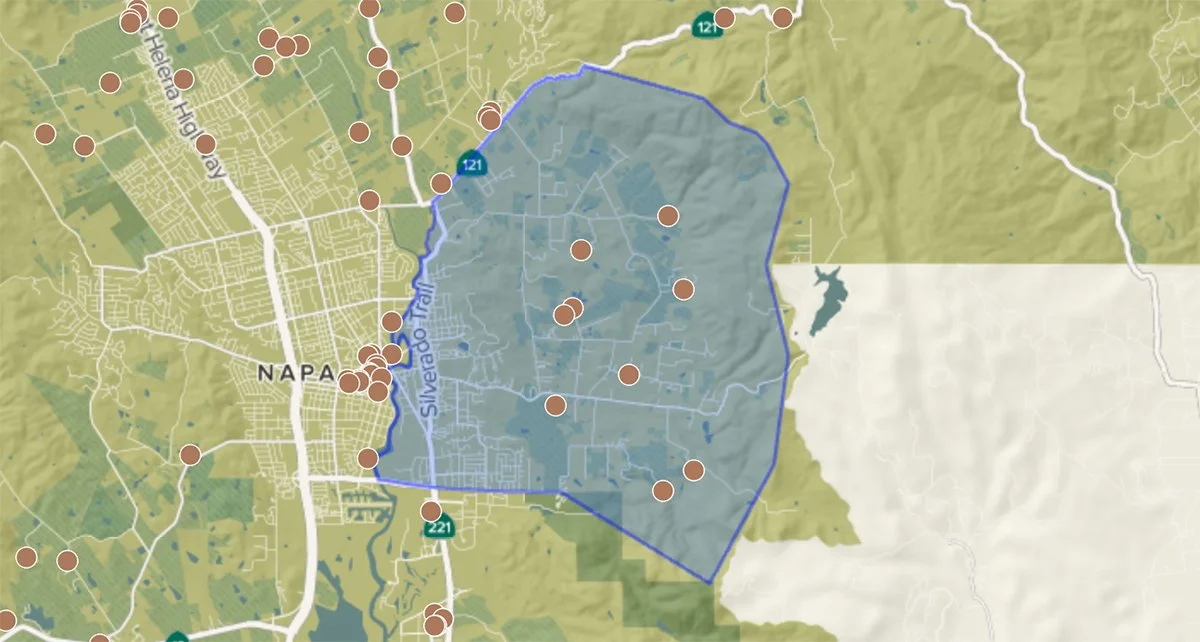
Coombsville was approved as Napa Valley's sixteenth nested AVA on December 14, 2011, after a petition led by Tom Farella of Farella-Park Vineyards and Bradford Kitson. The appellation covers approximately 11,075 acres east of the city of Napa, with about 1,430 acres planted to vines as of recent counts. Despite a winegrowing history that reaches back to the 1870s, Coombsville remains one of the least-visited of Napa's sub-appellations — and increasingly one of its most exciting.
The geology is striking. Coombsville sits inside the remnants of an ancient volcanic caldera, with a horseshoe-shaped ring of mountains rising on its eastern side and the Napa River bottom on the west. The land has been called the "cup and saucer" appellation for the distinctive shape of its surrounding hills. Soils are dominated by volcanic rhyolitic tuff, ancient lava flows, and weathered alluvial deposits from Mount George, often layered with volcanic ash and gravel. Elevations climb from near sea level along the Napa River to 1,900 feet on the eastern ridge.
Coombsville's climate is what truly sets it apart. Proximity to San Pablo Bay, less than five miles to the south, draws cool marine air and morning fog into the appellation almost daily during the growing season. Daytime summer highs can be ten degrees cooler than the up-valley appellations, with heat spikes far less severe and a much longer growing season. Vines bud early and grapes ripen late, often among the last harvested in the valley.
The appellation was historically associated with Pinot Noir and Chardonnay, and the famous Haynes Vineyard Chardonnay planting from 1967 helped establish that reputation. In the late 1970s, Frank Farella planted Cabernet Sauvignon and Merlot against the consensus advice of his peers, proving that Bordeaux varieties could thrive in Coombsville's cooler conditions. Today the AVA grows Cabernet Sauvignon as its leading variety, joined by Merlot, Cabernet Franc, Syrah, Petite Sirah, Chardonnay, and Pinot Noir. The wines tend to show precision, minerality, soft yet significant tannins, freshness, and aromatic lift — qualities increasingly prized as Napa wine evolves. Producers include Palmaz Vineyards, Caldwell, Favia, Tournesol, Farella, Porter Family, Sciandri, Maroon, and others.
For wine buyers, Coombsville offers an alternative to ripe central-valley Cabernet — structured, savory, fresh, ageworthy, and frequently more reasonably priced than its up-valley neighbors. For visitors, the area's rolling hills, horse properties, and small wineries feel like a Napa that has stayed quieter than the rest. For property buyers, Coombsville offers proximity to the city of Napa, scenic landforms, and vineyard parcels in an appellation whose reputation is still rising — an unusual combination of access and discovery.
