
ATLAS PEAK AVA
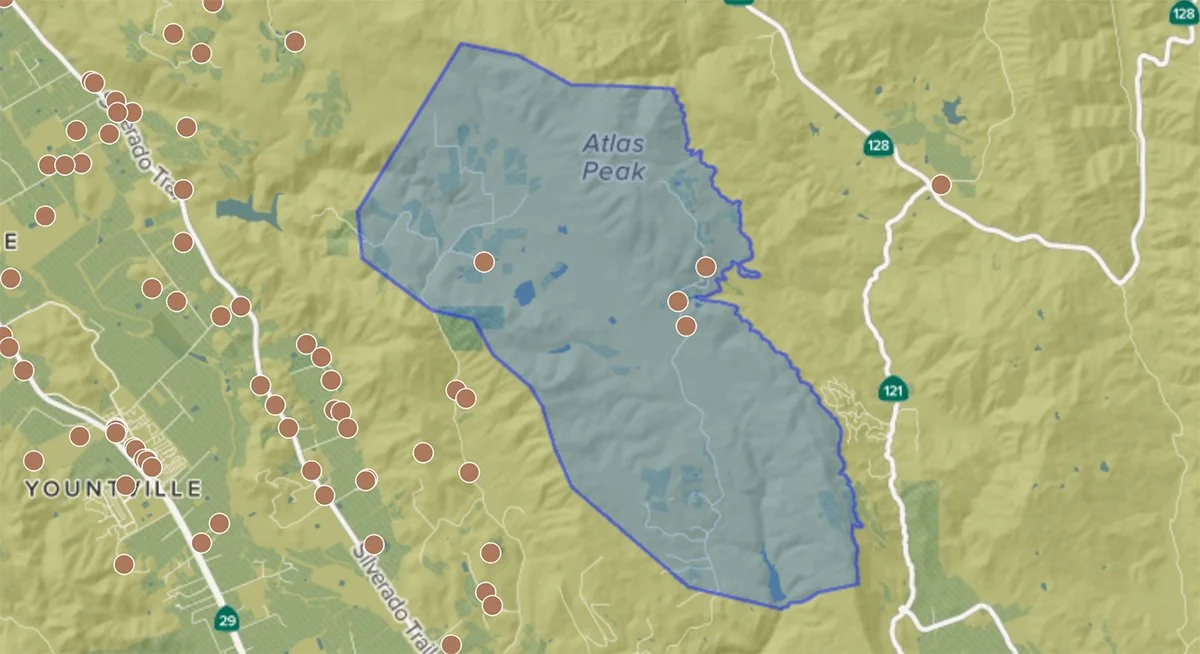
The Atlas Peak AVA was approved in 1992 and sits high on the western slopes of the Vaca Range, with elevations climbing from 760 feet to the summit at 2,663 feet — the highest peak in Napa Valley. Most vineyards are planted above the fog line, around or above 1,400 feet, on roughly 1,500 acres of land within the appellation's 11,400-acre footprint. The combination of elevation, volcanic geology, and proximity to San Pablo Bay produces wines unlike anything from the valley floor below.
Soils across Atlas Peak are almost uniformly volcanic — ancient rhyolite and andesite, basaltic red earth, fine ash, and rocky outcroppings of tuff. They are shallow, well-drained, and low in fertility, which limits vine vigor and yields small, thick-skinned grapes. Daytime summer temperatures run roughly ten to fifteen degrees cooler than the valley floor, but the appellation experiences dramatic diurnal swings, sometimes thirty degrees or more between afternoon high and overnight low. The result is grapes that develop full phenolic ripeness slowly while retaining naturally bright acidity.
History on the mountain is shorter than in valley-floor appellations. William Hill planted commercial vineyards here in the 1980s, and Piero Antinori — heir to the storied Tuscan wine family — co-founded Atlas Peak Vineyards on roughly 1,200 acres after acquiring Hill's property. Antinori initially planted significant Sangiovese, betting on the Italian variety; the project has since evolved into Antica Napa Valley, with a focus on Cabernet Sauvignon, Cabernet Franc, and Chardonnay grown on hillside sites near 1,800 feet. Jan Krupp founded Stagecoach Vineyard in 1995 on neighboring land; the 600-acre planting, sold to E. & J. Gallo in 2017, supplies grapes to roughly 90 wineries. Other producers on the mountain include Chappellet, Acumen, Au Sommet, Sill Family Vineyards, and Black Stallion.
Cabernet Sauvignon dominates, joined by Merlot, Petit Verdot, Cabernet Franc, Syrah, Sangiovese, and Chardonnay. Atlas Peak Cabernet is structured and dense, marked by dark berry fruit, mountain herbs, graphite, cocoa powder, and a distinctive minerality from the volcanic soils. The wines are typically firm and concentrated in youth, often requiring time in bottle to integrate their tannins. Chardonnay from Foss Valley, at slightly lower elevation, expresses the mountain's cooler temperatures with bright acidity and stone-fruit character.
For wine buyers, Atlas Peak represents the connection between volcanic terroir and structure, and the appellation's relatively low production gives its wines a degree of scarcity. For visitors, the winding roads up Soda Canyon and Atlas Peak Road open onto some of the most dramatic vistas in Napa Valley, with Antinori-Antica offering particularly rewarding tastings. For property buyers, Atlas Peak combines mountain privacy with a working agricultural community where cattle ranches and vineyards still share the landscape.
