
NAPA VALLEY AVA
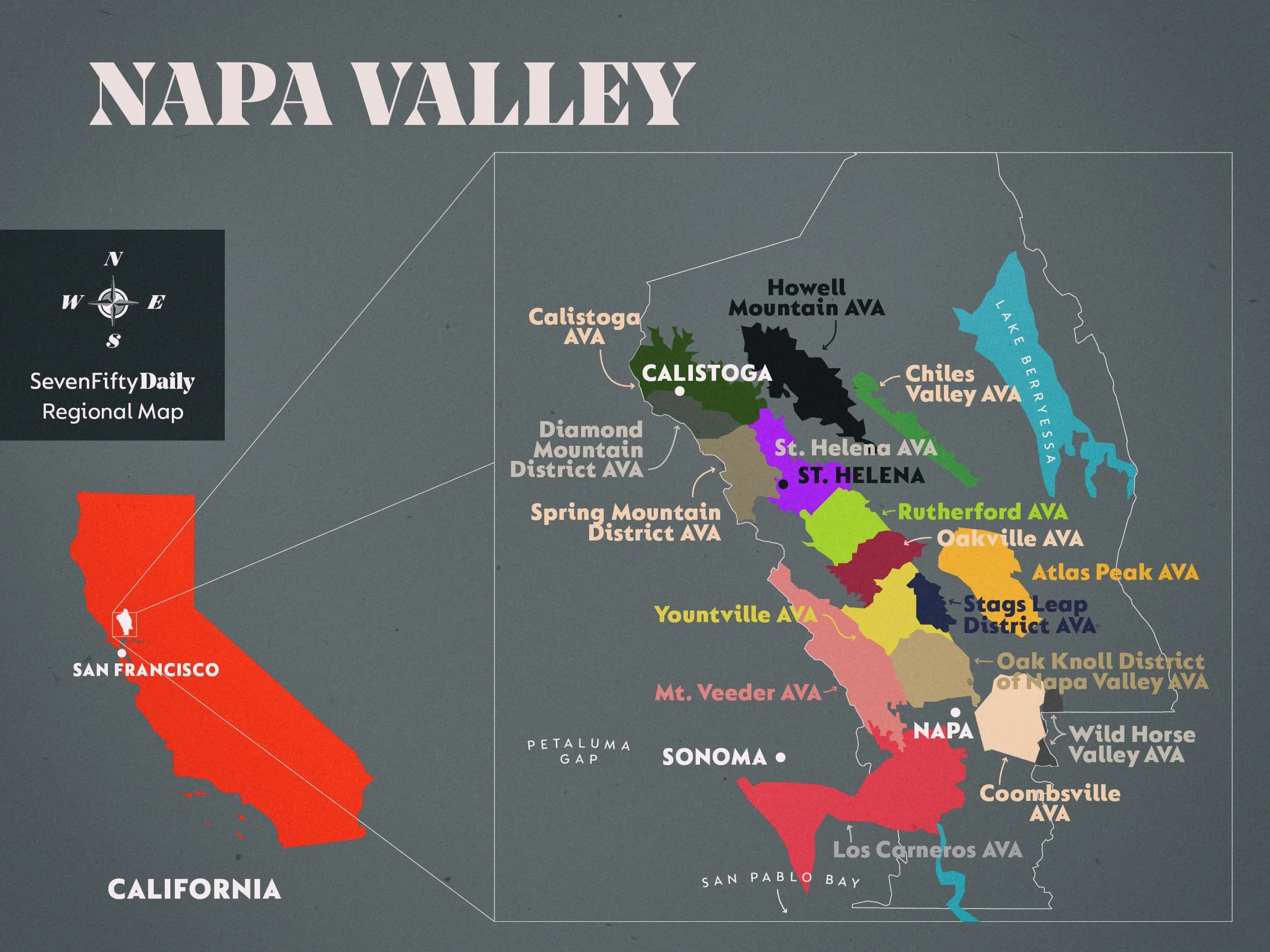
The Napa Valley American Viticultural Area was established in 1981, becoming California's first recognized AVA and only the second in the United States. It stretches roughly thirty-five miles from south to north, narrows to a width of one to four miles, and contains within it seventeen nested sub-appellations, each shaped by distinct geology, climate, and elevation. Within a relatively small geographic footprint, Napa Valley produces only about four percent of California's wine yet sets the international benchmark for American Cabernet Sauvignon and a great many other varieties.
The valley sits between two mountain ranges — the Mayacamas to the west and the Vaca to the east — that channel cool marine air northward from San Pablo Bay. That maritime influence, combined with a long, dry Mediterranean growing season and dramatic diurnal temperature shifts, creates conditions in which grapes ripen fully while retaining acidity. Soils tell a similarly varied story: ancient alluvial fans on the valley floor, volcanic deposits from the Vaca Range, sedimentary loams along the river, and red iron-rich soils high on the mountains. The valley floor rises gradually from sea level near the city of Napa to about 362 feet in Calistoga, beneath Mount St. Helena.
Napa's modern viticulture began with George C. Yount, who planted the valley's first grapevines in 1838. John Patchett established the first commercial vineyard in 1858, and Charles Krug opened the valley's first commercial winery in St. Helena in 1861. By 1880, Napa Valley had 443 vineyards of significant scale. Phylloxera, Prohibition, and the Depression devastated the industry, and recovery was slow until the 1960s, when Robert Mondavi opened his eponymous winery in 1966 and inaugurated the modern era. The 1976 Judgment of Paris — at which a 1973 Stag's Leap Wine Cellars Cabernet placed first ahead of top Bordeaux estates and a 1973 Chateau Montelena Chardonnay won the white category — confirmed Napa's place among the world's great wine regions.
Cabernet Sauvignon dominates plantings and reputation, but the valley produces serious Chardonnay, Merlot, Sauvignon Blanc, Pinot Noir, Zinfandel, and traditional-method sparkling wine. The nested AVAs — including Stags Leap District, Oakville, Rutherford, St. Helena, Calistoga, Howell Mountain, Atlas Peak, Coombsville, Oak Knoll District, Yountville, and Los Carneros — each express a particular intersection of soil and microclimate. Conjunctive labeling laws require any wine bearing a nested AVA name to also list "Napa Valley," reinforcing the umbrella identity.
For visitors, Napa Valley today supports more than 475 wineries and welcomed roughly 3.7 million visitors in 2023, according to Visit Napa Valley's 2023 Visitor Profile and Economic Impact Study — down modestly from a pre-pandemic peak of 3.9 million in 2018. The valley's 1968 Agricultural Preserve, the first such designation in the United States, protects nearly ninety percent of the region from non-agricultural development, ensuring that vineyards remain the defining land use. For buyers, that scarcity translates into some of the most coveted rural real estate in the country: a finite footprint of farmable land, protected by ordinance, surrounded by infrastructure built for hospitality. Whether the entry point is a tasting room in Oakville or an inn in Calistoga, Napa Valley remains what it has been for nearly half a century — the standard by which American wine is measured.
