
STAGS LEAP DISTRICT AVA
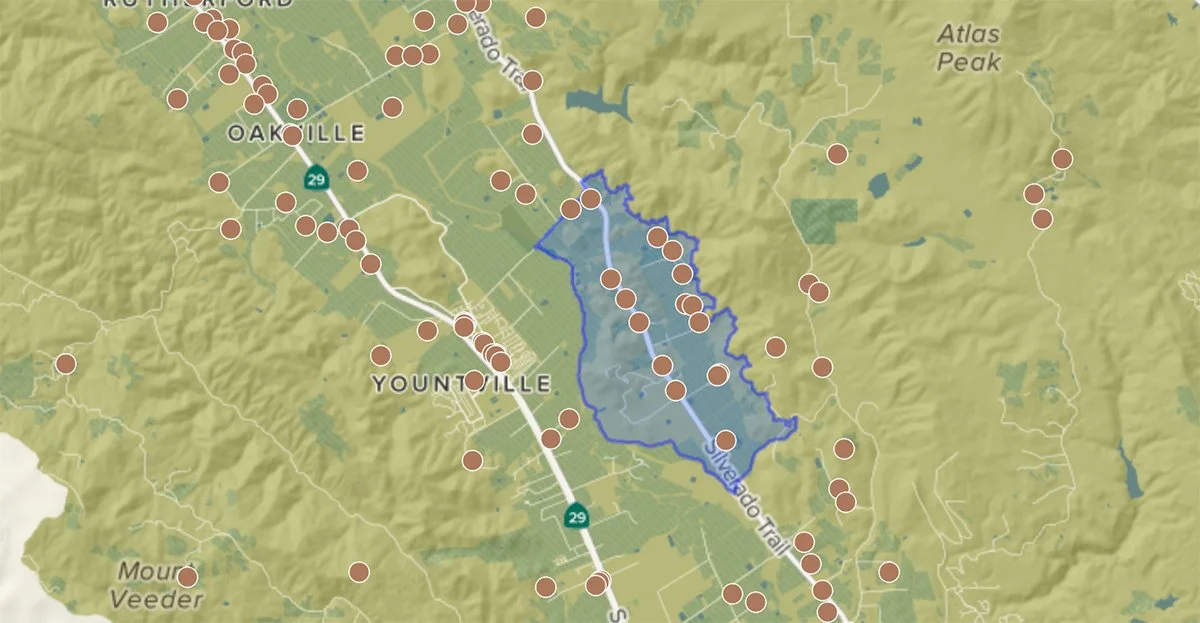
The Stags Leap District is a valley within a valley. Compact — roughly three miles long and one mile wide — it occupies about 2,700 acres on the eastern side of the Napa Valley floor, between the dark basalt cliffs known as the Stags Leap Palisades and the Napa River. More than half of that acreage is planted to vines, and Cabernet Sauvignon overwhelmingly dominates, with Merlot, Petit Verdot, Malbec, and Cabernet Franc playing supporting roles in Bordeaux-style blends.
The geology that made the district famous is unusual even by Napa standards. Established in 1989, Stags Leap was the first American Viticultural Area approved primarily on the basis of distinctive soils. The dominant Bale loam series brings gravelly, clay-rich sediments laid down by the Napa River, layered over volcanic material — rhyolitic tuff and andesite — eroded from the Vaca Mountains. The Palisades themselves radiate the day's heat back across the vineyards in the afternoon while cool marine air funnels in from San Pablo Bay each evening, creating a generous diurnal swing that builds color, flavor, and balanced acidity in the fruit.
History elevated the district almost overnight. Nathan Fay planted the area's first Cabernet Sauvignon in 1961, when conventional wisdom held that the climate was too cool for the variety. Warren Winiarski founded Stag's Leap Wine Cellars in 1970, and at the 1976 Judgment of Paris his 1973 S.L.V. Cabernet placed first in the red wine category, ahead of Château Mouton-Rothschild, Château Montrose, and Château Haut-Brion. That blind-tasting result, organized by Steven Spurrier and witnessed only by journalist George Taber, recalibrated international perception of California wine. John Shafer arrived in the district from Chicago in 1972, terraced steep hillsides, and helped establish what became Shafer Vineyards. Pine Ridge, Clos du Val, Cliff Lede, and Stags' Leap Winery round out a roster of producers who shaped the district's modern identity.
Stylistically, Stags Leap Cabernet is often described as an iron fist in a velvet glove — concentrated dark fruit, polished tannin structure, and a sense of restraint unusual in such ripe wines. The combination of warm afternoons, cool nights, and well-drained, low-fertility soils consistently produces wines that age with grace and reward patience in the cellar.
For wine buyers, the district matters because it offers Napa's most refined expression of Cabernet at scale: not the biggest wines, but among the most balanced. For visitors, the Silverado Trail runs the length of the appellation, and a day spent moving among Stags Leap producers offers a rare opportunity to taste subtle terroir differences within a single mile-wide strip of valley. For real estate, the district remains one of the most prestigious vineyard addresses in California, with parcels rarely changing hands and prices set by the wines they produce.
