
SPRING MOUNTAIN DISTRICT AVA
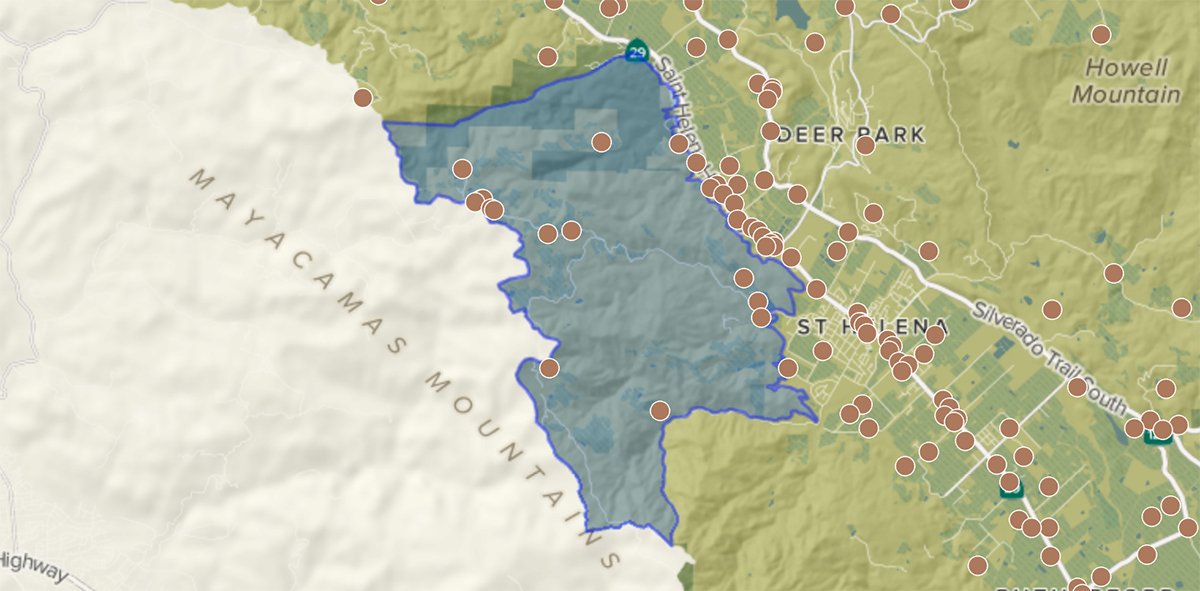
Rising on the steep eastern slopes of the Mayacamas Mountains above St. Helena, the Spring Mountain District AVA is one of Napa's most atmospheric mountain appellations. The Bureau of Alcohol, Tobacco and Firearms approved it on May 13, 1993, after a petition initiated by Michael Marston of Marston Vineyards and Fritz Maytag of York Creek Vineyards. The district takes its name not from a single peak but from the many natural springs that emerge throughout the area, which Spring Mountain Road follows as it climbs from the valley floor to the Sonoma County line.
Spring Mountain's terroir is famously complex. The appellation covers about 8,600 acres with roughly 1,000 acres planted, and its east-facing slopes range from 400 to 2,600 feet in elevation. Soils are a near-equal mix of sedimentary and volcanic origin: Franciscan sandstone, conglomerate, and pockets of marine shale in the south, with andesitic volcanic material more prevalent in the north near the Diamond Mountain border. The terrain is steep and heavily forested with oak, madrone, Douglas fir, and redwood, so vineyard blocks tend to be small, terraced, and surrounded by woodland. According to the Spring Mountain District winegrowers association, the appellation is the coolest and wettest in Napa Valley, with total precipitation reaching 70 to 95 inches in the wettest years.
Climate sets Spring Mountain apart even within the Mayacamas. Because the appellation sits only thirty miles east of the Pacific and faces a gap in the coastal range near Bodega Bay, cool marine air spills over the western ridge on summer afternoons, sometimes as visible waterfalls of fog that tumble through the canyons. Days are moderate rather than hot, nights warm gradually rather than plummet, and the diurnal swing is narrower than down on the valley floor. The result is Cabernet Sauvignon of unusual aromatic lift and finely woven tannin structure, alongside serious work in Merlot, Cabernet Franc, Chardonnay, Riesling, and even Syrah and Viognier on warmer rocky sites.
The producer list reads like a history of Napa's quiet ambition. Stony Hill Vineyard, founded by Fred and Eleanor McCrea on a former goat ranch in 1943, planted Chardonnay cuttings from Wente in 1948 and made its first Chardonnay vintage in 1952, going on to become beloved for Burgundian-style, age-worthy whites; the estate was sold to Long Meadow Ranch in 2018 and again in December 2020 to Gaylon Lawrence Jr. and Master Sommelier Carlton McCoy Jr. under the Lawrence Wine Estates umbrella. Cain Vineyard & Winery, founded in 1980 by Jerry and Joyce Cain on the historic 550-acre McCormick Ranch, became famous for Cain Five, a Bordeaux blend grown in a single high-elevation bowl between 1,400 and 2,100 feet; the 2020 Glass Fire destroyed the winery and roughly 90 percent of the 90 acres of vines, and Cain is now on a multi-year replanting program under winemaker Christopher Howell. Pride Mountain Vineyards straddles the Napa-Sonoma line at the ridgetop and is celebrated for deeply structured reds. Smith-Madrone, Spring Mountain Vineyard (the Falcon Crest house), Robert Keenan Winery, Paloma Vineyard, and Barnett Vineyards round out a roster of small, family-scale producers.
For property buyers, Spring Mountain offers something increasingly rare in Napa: dense forest, real elevation, and a sense of remove that feels closer to the Sierra foothills than to Highway 29, while still sitting fifteen minutes from downtown St. Helena.
