
MOUNT VEEEDER AVA
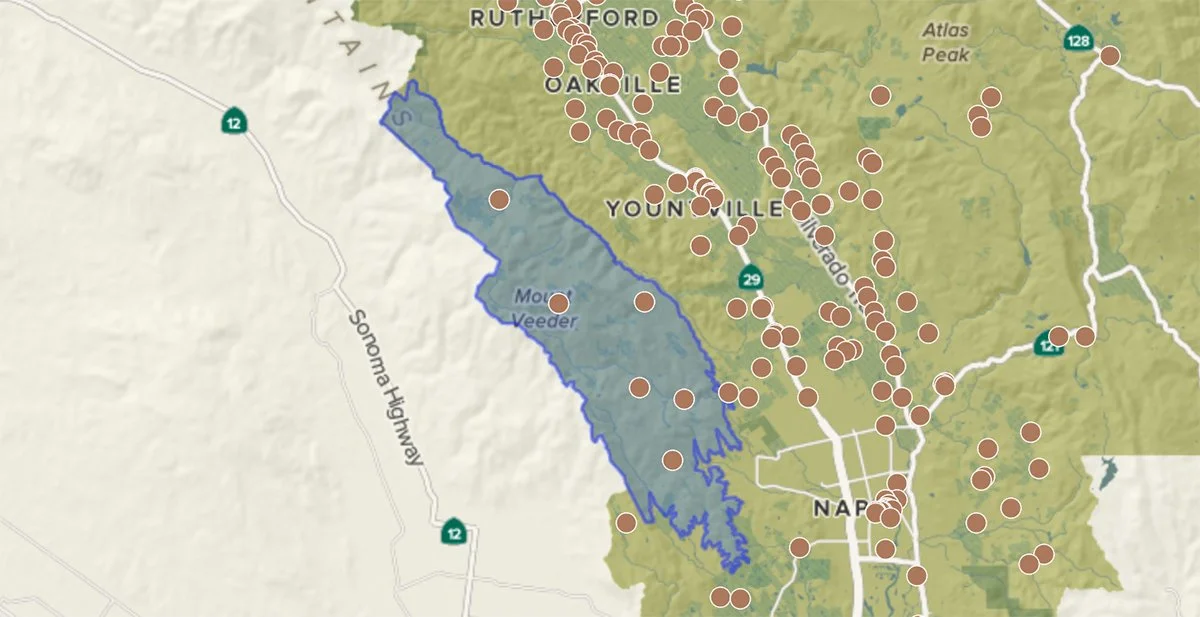
Mount Veeder rises along the western edge of southern Napa Valley, its rugged folds covering more ground than any other Napa AVA — roughly 25 square miles — yet planted to only about 1,000 vineyard acres. The appellation was approved on March 22, 1990, taking its name from Reverend Peter V. Veeder, a Napa Presbyterian minister and avid hiker who explored the mountain in the 1850s and 1860s. The Mount Veeder name appeared on a wine label as early as 1864 from the old Mt. Veeder Winery, and it carries one of Napa's longest documented histories of mountain viticulture.
What makes Mount Veeder geologically distinct is its origin. While most Napa mountain appellations sit on volcanic soils, Mount Veeder is built on an ancient, uplifted seabed of Franciscan sandstone and shale, with thin pockets of volcanic material only at the highest elevations. Vineyards range from roughly 500 to 2,600 feet and cling to slopes between ten and thirty degrees, with topsoil rarely deeper than a foot or two. According to the Mount Veeder Appellation Council, yields on the mountain are exceptionally low, usually 2 to 2.5 tons per acre for Cabernet Sauvignon, about half the Napa Valley average. Mount Veeder is also the only Napa mountain AVA that adjoins Carneros, which means cool marine air from San Pablo Bay rises directly into its southern vineyards.
That bay-and-mountain combination shapes a long, gentle growing season that few other Napa sites can match. Fog and cool air from Carneros temper daytime highs while elevation buffers nighttime cooling, producing a narrower diurnal range than the Napa floor and a harvest that often stretches into late October or November. Cabernet Sauvignon is the signature variety, but Mount Veeder also produces some of California's most distinctive Syrah, Merlot, Chardonnay, and Zinfandel. The wines share a recognizable Mount Veeder profile: dark color, fine-grained but assertive tannins, savory herb and graphite notes, and a silken, lingering finish that growers and winemakers commonly attribute to the combination of shallow soils and prolonged ripening.
Among notable producers, Hess Persson Estates (founded as The Hess Collection in 1986 by Donald Hess) occupies the historic Theodore Gier winery building dating to 1903 and remains the most visible Mount Veeder destination, with a celebrated contemporary art museum on site. Mayacamas Vineyards, established in 1889 and located near the summit, is one of California's most legendary producers of structured, long-lived Cabernet and Chardonnay. Mount Veeder Winery itself was founded in 1973 by Michael and Arlene Bernstein. Other respected names include Lagier Meredith (founded by viticulturist Carole Meredith), Lokoya, O'Shaughnessy Estate, and Progeny.
For real estate, Mount Veeder offers something the valley floor cannot: privacy, elevation, and Pacific views, often within a thirty-minute drive of downtown Napa. Parcels are large by necessity given the terrain, and the limited plantable acreage means that vineyard-bearing properties command real scarcity value.
