
DRY CREEK VALLEY AVA
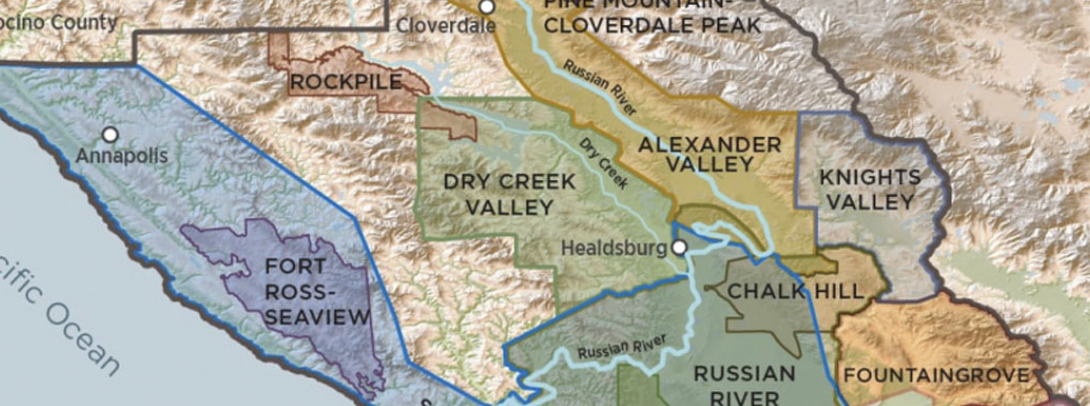
The Dry Creek Valley AVA was established on August 4, 1983, the second appellation designated in Sonoma County. The valley itself runs sixteen miles long by just two miles wide, tucked between Alexander Valley to the east and the higher Rockpile AVA to the north, with the Russian River Valley AVA forming its southern boundary. Within roughly 80,000 acres of land, about 9,300 acres are planted to vines. According to Wikipedia's Dry Creek Valley AVA article, "Over 94 wineries are resident in Dry Creek Valley and over 160 produce wines labeled with the Dry Creek Valley appellation" — making it remarkably dense for its small footprint. There are no stoplights — and effectively just one main road through.
Dry Creek Valley's identity is inseparable from Zinfandel. The first vineyards were planted by French immigrant Georges Bloch in the 1870s, and by the 1880s the valley had nine wineries and 883 acres in vines, half of them Zinfandel. Italian and Swiss immigrants followed, recognizing a geography that reminded them of Tuscany and Piedmont, and planted Petite Sirah, Carignane, and Zinfandel for hearty red blends. Prohibition forced most of the valley to convert to plum, pear, and prune orchards, but blocks of old Zinfandel survived — some more than a century old — often head-trained with no trellis, their gnarled arms still producing concentrated fruit each harvest. Roughly 2,400 acres of Zinfandel remain in the valley today, one of the densest concentrations of old-vine Zinfandel anywhere in the world.
The valley's modern wine renaissance began with David S. Stare, who in 1972 purchased a former prune orchard and founded Dry Creek Vineyard — the first new winery built in the valley after Prohibition. Stare planted Sauvignon Blanc against contemporary advice, modeled his wine on Loire Valley Pouilly-Fumé, and released the first Sonoma County Fumé Blanc in 1972. He went on to pioneer the Dry Creek Valley AVA designation, become a founding member of the Meritage Alliance, and coin the use of "Old Vine" on a Zinfandel label, beginning with the 1987 vintage. Other key producers include Ridge Vineyards Lytton Springs (whose straw-bale tasting room overlooks century-old Zinfandel vines), A. Rafanelli, Quivira, Pedroncelli (a Prohibition-era survivor founded 1927), Mauritson, Seghesio Family Vineyards, Preston Farm and Winery, and Lambert Bridge.
Climate is warm but moderated. Morning fog reaches the valley through the lower Russian River drainage, then burns off to allow hot, sunny afternoons. Soils vary considerably across the small footprint — metamorphic red rocky soils on the western benchlands, lighter brown igneous gravels for Bordeaux varieties and Zinfandel, well-drained sedimentary loams along the valley floor that suit Sauvignon Blanc and Chardonnay. The result is a striking range of styles within a compact appellation.
Dry Creek Zinfandel is the appellation's signature — bold, brambly, peppery, often blended with Petite Sirah and Carignane for added structure. Sauvignon Blanc, especially Stare's Fumé Blanc, established a distinctly Sonoma style: crisp, citrus-driven, food-friendly. Cabernet Sauvignon performs notably well on the warmer hillside sites, and Rhône-style blends of Grenache, Syrah, and Mourvèdre are increasingly serious. For wine buyers, Dry Creek represents the country's most reliable address for great Zinfandel and a deepening source of complex Bordeaux and Rhône wines. For visitors, the valley's narrow road, family-owned wineries, and unhurried rural character offer one of the most personal experiences in California wine. For property buyers, Dry Creek combines genuine farming culture with vineyard land that still occasionally changes hands among families who have worked it for generations.
