
ALEXANDER VALLEY AVA
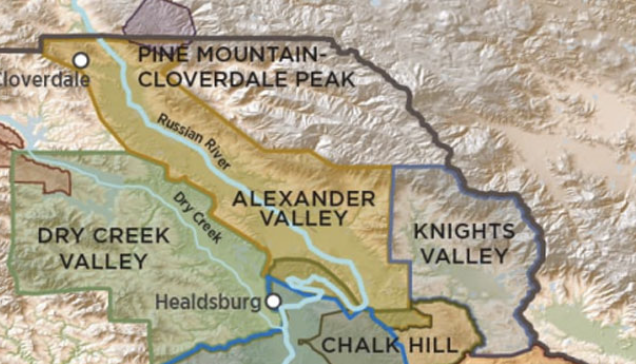
The Alexander Valley AVA was established on October 24, 1984, and remains one of Sonoma County's largest and most widely planted appellations. The boundary follows the Russian River corridor from Cloverdale south to Healdsburg, covering roughly 76,000 total acres with about 15,000 acres planted to vines — the most fully cultivated wine region in the county. The valley takes its name from Cyrus Alexander, a Rocky Mountain trapper who arrived in the 1840s and is generally credited as the first to plant grapes in the region.
Alexander Valley is the warmest of Sonoma's principal AVAs. Summer daytime temperatures regularly reach the mid-90s on the valley floor — warmer than the Sonoma Coast by a significant margin and comparable to the warmer sections of Napa Valley. What rescues the wines from heaviness is the dramatic diurnal swing: the Pacific marine influence reaches the valley through the lower Russian River corridor, dropping nighttime temperatures by 30 to 40 degrees. That swing builds full phenolic ripeness while preserving the acidity that makes Cabernet Sauvignon worth cellaring.
Soils across the appellation are varied, with gravelly, well-draining alluvial loams along the valley floor and rockier benchland and hillside sites at higher elevations — vineyards climb to roughly 2,500 feet in places. Roughly half of all plantings are Cabernet Sauvignon, with the variety dominating the AVA's identity. Zinfandel, Merlot, Cabernet Franc, Syrah, Sangiovese, Chardonnay, and Sauvignon Blanc all thrive in different micro-climates within the valley's five recognized districts.
Modern Alexander Valley emerged in the 1960s. Rodney Strong arrived in 1962 and helped revive commercial winegrowing; his 1974 Alexander Valley Cabernet was Sonoma County's first vineyard-designated Cabernet Sauvignon. Robert Young planted 14 acres of Cabernet on the family's Geyserville ranch in 1963 — the first modern Cabernet plantings in the appellation — and the Robert Young Estate Winery was built in 1997. Alexander Valley Vineyards sits on Cyrus Alexander's original homestead, having been planted by Harry and Maggie Wetzel in 1962 and now operating into a fourth generation. Jordan Vineyard & Winery, founded in 1972, has consistently produced age-worthy Cabernet and Chardonnay; other notable producers include Silver Oak (whose Alexander Valley winery complements its Oakville sister estate), Stonestreet, Ferrari-Carano, Simi, Chateau Souverain, Garden Creek, and the Stuhlmuller family.
The style of Alexander Valley Cabernet is generally rich, fleshy, and approachable — fully ripe black cherry and cassis fruit, smooth tannins, and a softer profile than typical Napa Cabernet. Some critics describe a signature chocolate note in the wines, attributable to the warm climate and alluvial soils. Sauvignon Blanc and Chardonnay grown in the appellation tend toward riper, fuller-bodied styles.
For wine buyers, an Alexander Valley Cabernet often represents the closest Sonoma equivalent to Napa Cabernet, frequently at more accessible prices and with friendlier early drinkability. For visitors, the valley offers a quieter, more rural alternative to the Napa Valley's central corridor, with wineries and vineyards interspersed with cattle ranches and orchards. For property buyers, Alexander Valley combines genuine winegrowing prestige with rural land at scales that have grown harder to find elsewhere in California wine country.
