
SONOMA VALLEY AVA
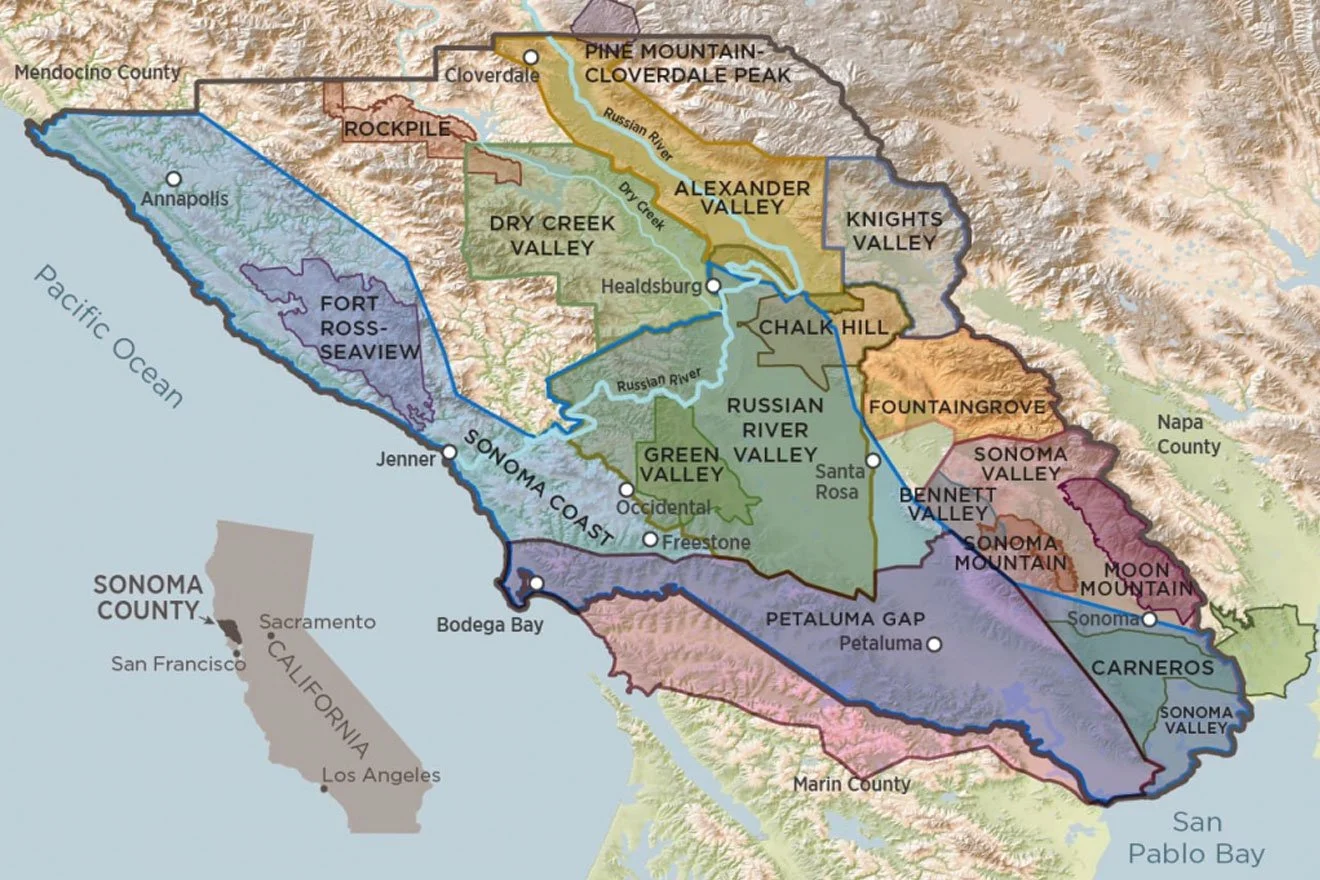
Sonoma Valley is widely regarded as the birthplace of California's commercial wine industry. The first vines were planted by Franciscan friars at Mission San Francisco Solano in 1823, the last of the California missions. General Mariano Guadalupe Vallejo expanded those plantings in 1834 and established the town of Sonoma the following year. Then, in 1857, the Hungarian immigrant Count Agoston Haraszthy purchased the former Vallejo vineyard, renamed it Buena Vista, and built California's first stone winery buildings and wine caves. By the 1860s Haraszthy had returned from a European expedition with more than 100,000 vine cuttings representing hundreds of varieties — a foundational moment for North American viticulture.
The AVA itself was established on December 4, 1981, the ninth in the nation. The appellation covers approximately 72,400 acres between the Mayacamas Mountains to the east and the Sonoma Mountains to the west, with about 13,000 acres planted to grapes. The valley's indigenous Chocuyen name, Sonoma, translates as "Valley of the Moon," the title Jack London later gave to his novel and to the homestead he built in Glen Ellen in the early 1900s.
The valley's geography blends maritime and inland influences. The Sonoma Mountains protect the appellation from the heaviest Pacific fog, while cool air still reaches it through the San Pablo Bay opening to the south. Soils vary widely — gravelly loams along the valley floor, volcanic ash and clay on the slopes, alluvial fans from both ranges. Within the larger AVA sit several nested sub-appellations: Bennett Valley, Los Carneros (shared with Napa), Sonoma Mountain (rising to 2,400 feet), and the Moon Mountain District (with vineyards on fractured basalt and volcanic ash at 400 to 2,200 feet).
Sonoma Valley's diversity is its identity. Chardonnay accounts for the largest share of plantings, followed by Pinot Noir, Cabernet Sauvignon, Zinfandel, Merlot, and Sauvignon Blanc, with a long list of other varieties scattered across micro-climates. Historic producers anchor the appellation: Buena Vista (acquired by Boisset Family Estates in 2011) remains a National Register property and a working winery; Gundlach Bundschu, founded by Jacob Gundlach in 1858 on the 320-acre Rhinefarm estate, is California's oldest continuously family-owned winery; Sebastiani Vineyards (1904) survived Prohibition by producing sacramental and medicinal wines; Hanzell Vineyards (1953) pioneered stainless-steel fermentation and French oak in California and farms the oldest continually producing Pinot Noir and Chardonnay blocks in the Western Hemisphere.
For wine buyers, Sonoma Valley offers extraordinary stylistic range across a single appellation — bright cool-climate Chardonnay and Pinot from the south, structured Cabernet and Zinfandel from the warmer northern sections and the slopes. For visitors, the historic plaza in the town of Sonoma, the Jack London State Historic Park in Glen Ellen, and a less commercial atmosphere than Napa's mid-valley give the experience a softer, more pastoral quality. For property buyers, Sonoma Valley combines deep history, established infrastructure, and a degree of rural texture that has become harder to find in the more densely planted neighboring AVAs.
