
RUSSIAN RIVER VALLEY AVA
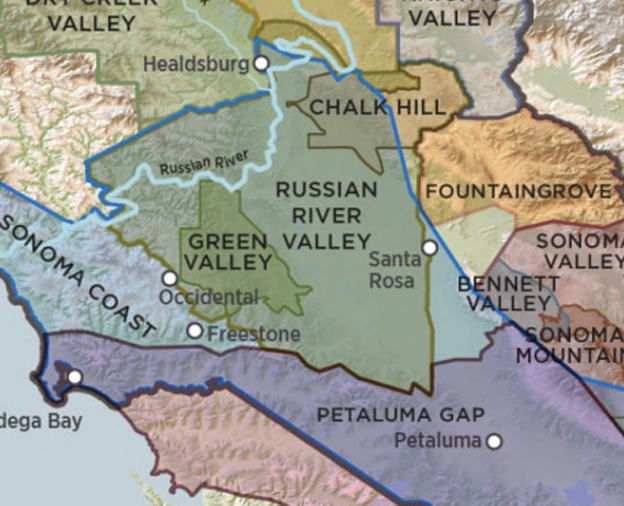
The Russian River Valley AVA was established in 1983 and expanded modestly in 2005. It now covers approximately 165,000 acres in central Sonoma County, running roughly from Sebastopol and Santa Rosa in the south to Forestville and Healdsburg in the north, following the meandering Russian River as it bends toward the Pacific. Within that footprint, vineyards account for roughly one-sixth of Sonoma County's total planted acreage, and the appellation has become the United States' most reliable address for serious Pinot Noir and Chardonnay.
Climate is the engine. With parts of the AVA less than ten miles from the Pacific, cool marine fog rolls in through the Petaluma Gap each evening and lingers well into the next morning. Daytime temperatures can warm into the mid-90s in summer, but nighttime lows drop into the 40s, producing diurnal swings of 35 to 40 degrees. That cooling extends the growing season — sometimes by twenty percent over neighboring inland regions — and allows grapes to develop complexity while preserving the bright acidity that defines the wines.
Soils tell an equally important story. The Russian River Valley is famously diverse, with more soil types within its 165,000 acres than France contains in its entire national territory, according to growers. The dominant series is Goldridge — a fine, sandy loam derived from ancient seabed sediment, well-drained and naturally low in vigor, ideally suited to Pinot Noir. Sebastopol soils, more clay-rich, support a different expression of the same variety. Franciscan Assemblage formations bring complexity in the western hills. Alluvial soils along the river itself support different blocks again.
The appellation includes several recognized sub-zones — Middle Reach, Santa Rosa Plains, Laguna Ridge, Green Valley (its own nested AVA), Sebastopol Hills, and the eastern hills — each with subtle variations of style. Pinot Noir is the appellation's headline grape, producing wines with red and dark cherry fruit, spice, soft tannins, and structural complexity. Chardonnay accounts for nearly half of plantings and yields wines of crisp minerality, tropical fruit, and racy malic acidity. Zinfandel grows on warmer hillside sites, and small plantings of Syrah, Pinot Gris, and Pinot Blanc round out the appellation. Historic producers — Rochioli, Williams Selyem, Dehlinger, Iron Horse, DeLoach, Davis Bynum, Foppiano, Hartford Family, MacRostie — built the modern reputation through the 1970s, '80s, and '90s.
For wine buyers, a Russian River Valley designation reliably means cool-climate Burgundian style with California's generosity of fruit. For visitors, the appellation's redwood-shaded back roads, riverside towns, and dense concentration of tasting rooms make for one of the most pleasant wine-country itineraries in the state. For property buyers, the valley combines genuine viticultural prestige with a rural character — farms, orchards, redwood groves — that contrasts with the more polished hospitality of Napa's central valley.
