
HOWELL MOUNTAIN AVA
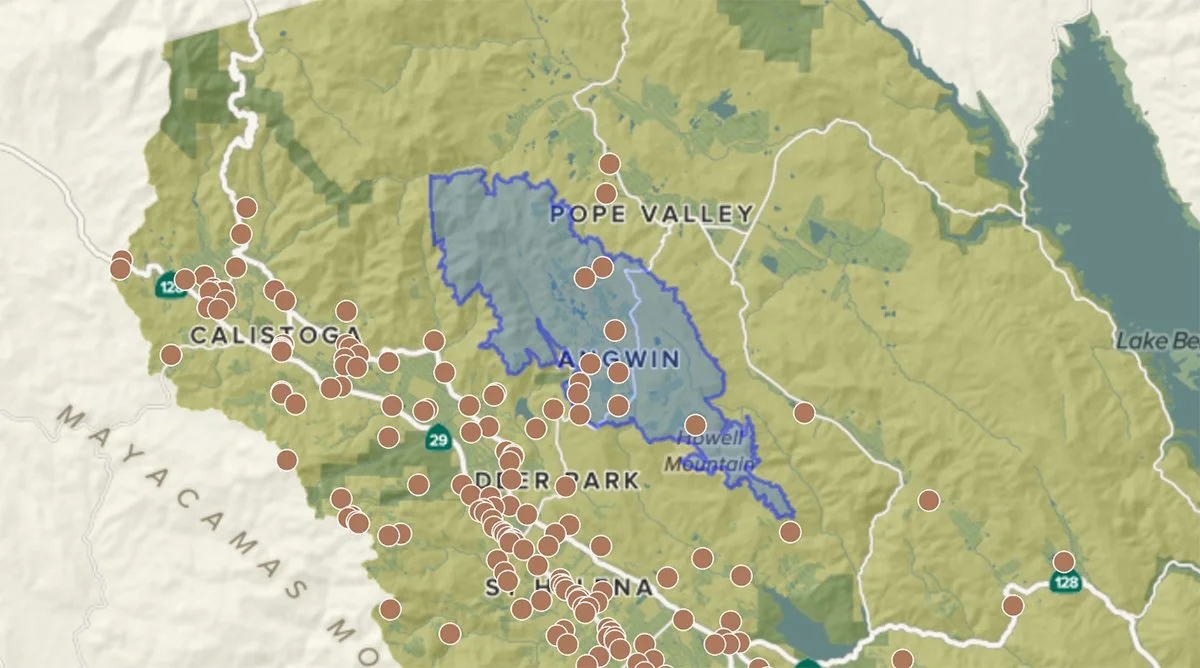
Howell Mountain became Napa Valley's first nested sub-appellation in December 1983, a recognition of terrain so distinct that even within Napa it stands apart. The AVA's boundary is defined not by a line on a map but by an elevation contour: vineyards must sit at or above 1,400 feet — the altitude at which the marine fog blanketing the valley floor reliably crests. The result is a roughly 14,000-acre appellation with about 1,500 acres under vine, perched above the fog with vineyards reaching as high as 2,600 feet.
Geology and elevation together define the wines. The two dominant soil types are tufa — decomposed volcanic ash, pale and shockingly white in places — and iron-rich red clay, both thin and nutrient-poor. Vines must work hard, sending roots deep through fractured rock for water and nutrients. The result is small clusters of small, thick-skinned berries with high skin-to-juice ratios, producing wines of intense color, concentrated flavor, and serious tannic structure. Above the fog, days are sunnier but cooler than the valley floor; nights are warmer than below, compressing the diurnal range and extending hang time. Rainfall is the highest in Napa Valley, but porous volcanic soils drain it away.
Howell Mountain's modern reputation owes much to Randy Dunn, who released his first Howell Mountain Cabernet in 1979 and quickly demonstrated that the mountain could produce some of the most ageworthy, structured wines in California. The appellation's commercial history reaches back to the 1880s, when French winemakers Brun and Chaix established a successful operation, and Charles Krug planted about 100 acres on the mountain by 1884. Prohibition emptied the mountain of commercial winemaking for fifty years, and recovery began only in the 1960s and 1970s. Today producers including Dunn Vineyards, La Jota, Cade, O'Shaughnessy, Robert Foley, Lamborn, Ladera, Robert Craig, Abreu, and Outpost anchor the appellation, often working in concert with growers such as Black Sears and Beatty Ranch.
Cabernet Sauvignon dominates and defines the style — massive, deeply tannic, marked by dried blackberry, graphite, forest floor, and earth, with the patience to evolve in bottle for two or three decades. Merlot, Zinfandel, Petite Sirah, and Cabernet Franc all perform notably well in the same conditions, with the appellation's old-vine Zinfandel offering a brambly, mountain expression unlike anything on the valley floor.
For wine buyers, Howell Mountain Cabernet rewards patience; these are not entry-point wines but cellar wines, often improving for twenty or more years. For visitors, the drive up from St. Helena is an experience in its own right, the curvy road passing through forest before opening onto vineyards at elevation. For real estate, Howell Mountain offers something rare in Napa: substantial parcels with privacy, view, and forest, often at lower per-acre prices than the valley floor — though the wines they produce sit comfortably alongside the most expensive in the country.
