
CALISTOGA AVA
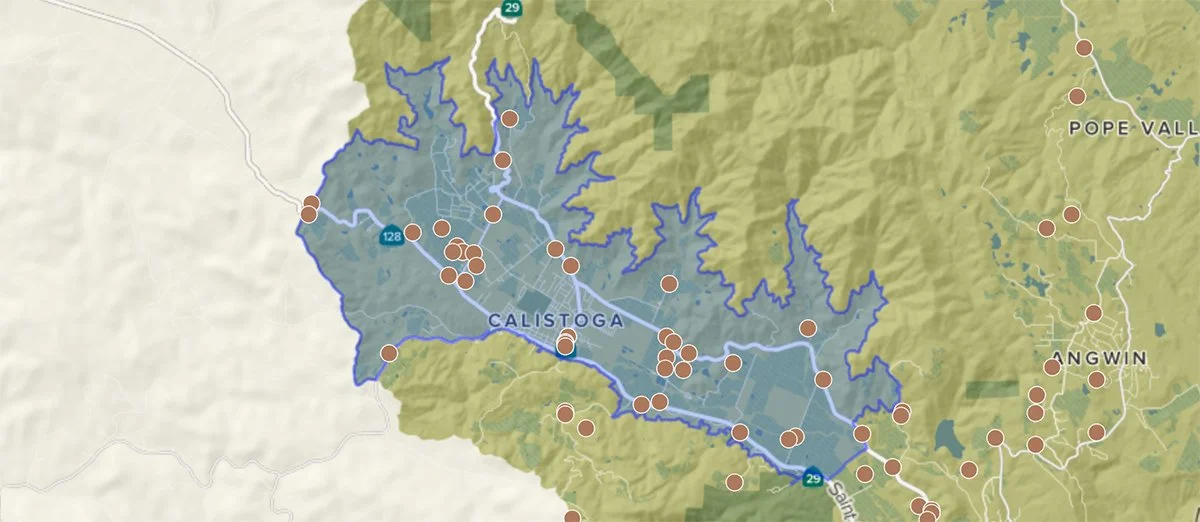
The Calistoga AVA was approved in late 2009, with an effective date of January 7, 2010, making it the fifteenth nested sub-appellation within Napa Valley. The petition was led by Bo Barrett of Chateau Montelena and required six years to navigate opposition from brands that had used Calistoga as a label term without sourcing fruit from the area. The result is a defined appellation of about 12,713 total acres, of which roughly 625 to 750 acres are planted to vines, anchoring the northernmost stretch of the Napa Valley floor.
What distinguishes Calistoga is geology and climate working in unison. Bedrock here is almost exclusively volcanic, a product of Sonoma Volcanic activity that occurred between four and ten million years ago. Above that bedrock the AVA offers fine and heavy ash, stone-studded loam, cobbles, and clay or silt in the alluvial fans — a range of soil profiles unified by their volcanic origin. Daytime summer temperatures regularly push past 100°F, while nighttime lows can drop to the low 40s, producing the largest diurnal temperature variation in Napa Valley. The constriction at the head of the valley, combined with cool air drawn through the Chalk Hill Gap from the Pacific, creates a thermal rhythm ideally suited to ripe but structured red wines.
The appellation's modern history begins with Samuel Brannan's 1859 land purchase and 1862 resort opening, but its winegrowing identity emerged in stages. Alfred Tubbs founded what is now Chateau Montelena in 1882; the property's 1973 Chardonnay won the white wine category at the 1976 Judgment of Paris, vaulting it to international fame. The Eisele Vineyard, planted in the 1880s, was farmed by Bart and Daphne Araujo from 1990 until summer 2013, when they sold the property to François Pinault's Artémis Group (also owners of Château Latour); the estate was renamed Eisele Vineyard Estate in 2016 and continues to produce some of California's highest-rated Cabernet Sauvignon and Syrah. Larkmead Vineyards, Frediani Vineyard (with 110-year-old Carignane vines), Kenefick Ranch, Switchback Ridge, and the Three Palms Vineyard (now exclusively contracted to Duckhorn) round out the AVA's historical pedigree.
Cabernet Sauvignon accounts for more than half of plantings and is the appellation's defining grape, producing wines with ripe black cherry, plum, and cassis underpinned by firm tannins and a distinctive mineral character attributable to the volcanic soils. Zinfandel and Petite Sirah, both with deep historical roots in Calistoga, thrive on the same terrain, yielding bold, spice-driven wines. Old-vine Charbono, a rare variety also known as Bonarda in Argentina, persists in a handful of Calistoga vineyards. Across all varieties, Calistoga wines share an unusual combination of full phenolic ripeness and preserved acidity, giving them both immediate appeal and serious cellar potential.
For wine buyers, a Calistoga designation indicates volcanic minerality and structured power rather than the more polished elegance of mid-valley appellations. For visitors, the AVA's compact footprint and the town's hot springs, geysers, and walkable Lincoln Avenue make it one of the most rewarding stops in Napa Valley. For property buyers, Calistoga combines geological distinctiveness with relative affordability compared to the central valley, and remains the appellation where individual vineyard sites still feel discoverable.
