
ST. HELENA AVA
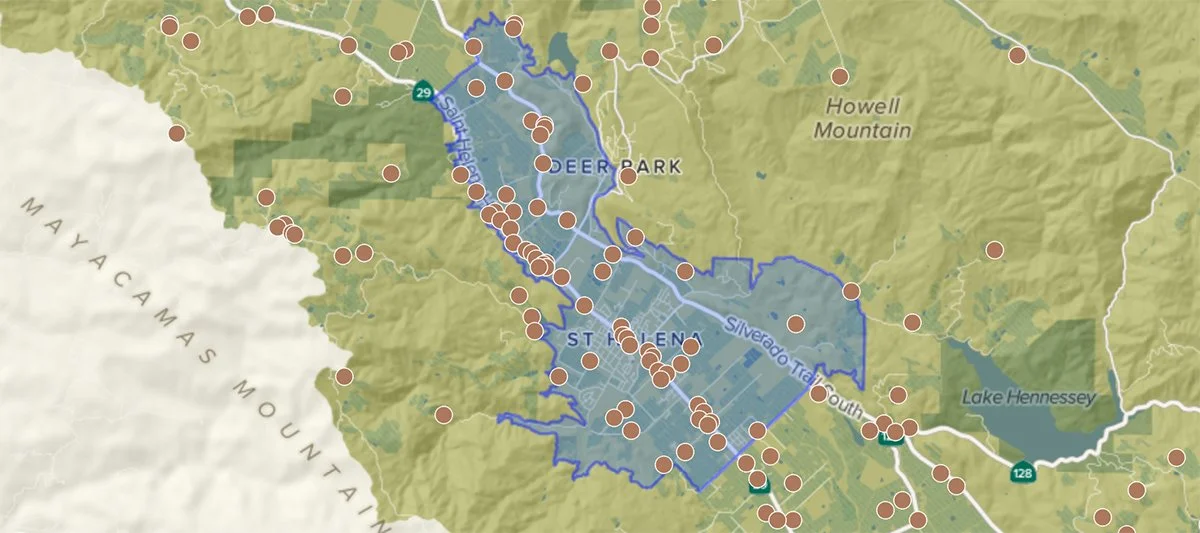
The St. Helena AVA was officially recognized in 1995, but its winegrowing history reaches back to the very origins of Napa Valley's commercial industry. Charles Krug founded the valley's first commercial winery in St. Helena in 1861, Dr. Crane and David Fulton followed within a year or two, and by the late nineteenth century the appellation was the undisputed center of Napa wine production. Today the AVA encompasses roughly 9,060 acres, of which approximately 6,800 are planted to grapes — more than any other AVA in Napa Valley — across more than 400 individual vineyards.
The appellation's shape is unusual: an hourglass that pinches at the narrowest point of the valley, where the Mayacamas and Vaca Mountains nearly meet. That geometry traps daytime heat between the surrounding hillsides while funneling cool night air through the constriction, producing some of the largest diurnal swings in the valley. Daytime summer highs can reach the mid-90s; nighttime lows often drop into the 40s. The result is grapes that ripen fully while retaining the acidity essential to ageworthy wine.
Soils are famously diverse. The St. Helena AVA contains roughly twenty-one different soil types within its boundaries, a result of alluvial fans descending from both mountain ranges and the centuries-long influence of a once-larger Napa River. The western benches carry gravelly loam derived from a mix of volcanic and sedimentary parent materials; the eastern side trends toward deeper, more fertile volcanic soils. Within a single vineyard, growers may manage several distinct soil profiles, each suited to different varieties, clones, and rootstocks.
Cabernet Sauvignon dominates, joined by Cabernet Franc, Merlot, Syrah, Zinfandel, Sauvignon Blanc, and Petite Sirah. The wines typically show pure, deeply layered blue and black fruit, ripe and luscious tannins with soft edges, and a supple, elegant texture. The northern half of the appellation, less moderated by bay breezes, produces richer, more decadent Cabernet in a style closer to Calistoga, while the southern half — protected by the Mayacamas — yields wines with more lift and structure, in the manner of northern Rutherford. Producers as varied as Charles Krug, Beringer Vineyards (the valley's oldest continuously operating winery, founded 1876), Hall, Spottswoode, Corison, and Anomaly all express that diversity.
For wine buyers, an St. Helena designation indicates depth, generosity, and a sense of place rooted in the appellation's historic heart. For visitors, the town of St. Helena sits at the center of the AVA, putting tasting rooms, restaurants, and overnight stays within walking distance of each other. For real estate, the appellation combines proximity to the valley's most established services with vineyard parcels that produce wines of unmistakable identity — a combination that has kept St. Helena at the top of Napa's hierarchy for more than a century and a half.
