
RUTHERFORD AVA
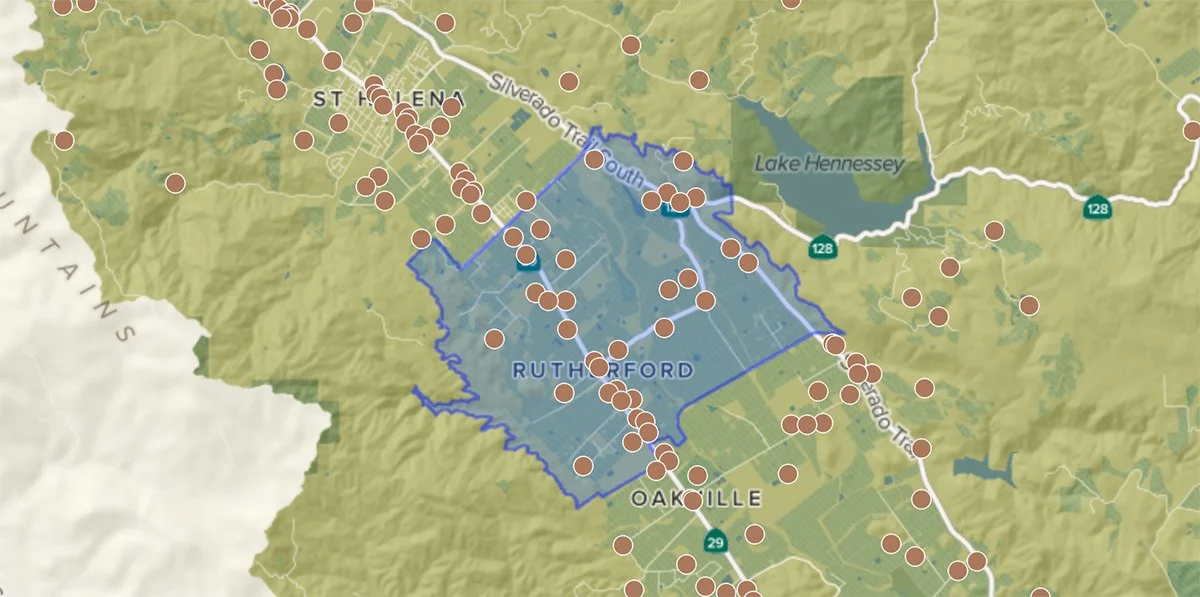
Rutherford occupies the geographic and historical heart of Napa Valley. Designated as an AVA on July 2, 1993, the appellation covers approximately 6,650 acres at the valley's widest point, flanked by the Mayacamas Mountains to the west and the Vaca Range to the east. The combination of position, sunshine hours, and soil has made Rutherford synonymous with classic Napa Cabernet Sauvignon for more than a century.
The land took its name from Thomas Rutherford, who married a granddaughter of George Yount in 1864 and received roughly 1,040 acres of vineyard land as a wedding gift. The community grew up around that ranch, and by the late 1800s a constellation of estates anchored the area's reputation. Inglenook was founded in 1879 by Finnish sea captain Gustave Niebaum and later restored by Francis Ford Coppola beginning in 1975. Beaulieu Vineyard was founded in 1900 by Georges de Latour, survived Prohibition by producing sacramental wine, and in 1938 hired Russian-born enologist André Tchelistcheff, whose 1936 Georges de Latour Private Reserve Cabernet became the first California wine to gain international recognition as a premier-cru-level bottling. Caymus Vineyards, established in 1972 by the Wagner family, introduced its Special Selection Cabernet in 1975, the only wine ever named Wine Spectator's Wine of the Year twice.
"Rutherford Dust" is the phrase Tchelistcheff coined for the texture he tasted in great Beaulieu Cabernets — a fine, dusty, cocoa-powder quality in the tannins that he believed inseparable from the appellation's signature character. Geologically, the term gestures at the predominance of Bale loam, a gravelly, sandy loam deposited as alluvial fans descended from the Mayacamas Mountains. The western Rutherford Bench is especially prized; its well-drained soils limit vine vigor, concentrate flavors, and lend the wines structure and longevity. Eastern Rutherford carries more volcanic influence and produces a slightly different style, while sites along the Napa River support Sauvignon Blanc of remarkable elegance.
Cabernet Sauvignon dominates Rutherford plantings, joined by Merlot, Cabernet Franc, Petit Verdot, and Sauvignon Blanc. The wines combine ripe dark fruit with the appellation's distinctive earthy, savory minerality and a tannic structure that ages gracefully for decades. The Rutherford Dust Society, founded in 1994, organizes growers and producers around the appellation's identity and was the first AVA association to achieve 100% participation in the Napa Green Land sustainability program.
For wine buyers, Rutherford remains the standard against which other Napa Cabernets are measured. For visitors, the cluster of historic estates along Highway 29 and the Silverado Trail offers a guided tour through the modern history of California wine. For real estate, parcels in Rutherford are among the most coveted in the valley, and the addresses themselves — alongside Inglenook, Beaulieu, Caymus, and the Beckstoffer-owned heritage vineyards — carry a gravitational weight that few other places in American wine country can match.
