
SONOMA COAST AVA
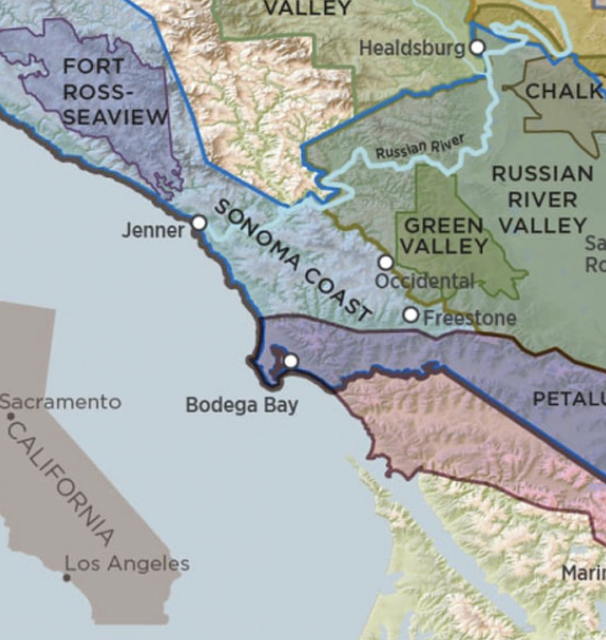
The Sonoma Coast AVA was approved in 1987 and covers roughly 500,000 acres along the Pacific edge of Sonoma County — one of the largest appellations in California, stretching from the Mendocino County line to the north all the way down to Marin County and across 76 miles of Pacific coastline. The breadth of the appellation has long been a source of frustration for serious cool-climate growers, who argued that wines from the rugged ridges close to the ocean deserved their own identity. That distinction came in 2022 with the approval of the West Sonoma Coast AVA, a 141,846-acre carve-out hugging the coast, which sits as an AVA within the larger Sonoma Coast.
The defining factor is the Pacific Ocean. Marine fog, cool ocean breezes, and the San Andreas Fault — which runs roughly parallel to the coast and has pushed ridgelines above 1,500 feet in places — together produce one of California's most challenging and rewarding viticultural environments. Temperatures along the true coast run ten degrees or more cooler than the rest of the Sonoma Coast AVA. Vineyards sit both above and below the fog line, on steep ridge tops and in protected hollows, and the ocean moderates both daytime heat and nighttime cold.
Soils in the western reaches reflect the geological violence of the region: greywacke sandstones, shales, ancient marine sediments, and volcanic deposits, jumbled by tectonic activity into a patchwork that changes within yards. Pinot Noir and Chardonnay dominate, joined by serious if smaller plantings of Syrah in cool-climate northern-Rhône style. Yields are typically low, grapes struggle to ripen at the edge of viability, and the resulting wines combine intense aromatic complexity with naturally restrained alcohol and bracing acidity.
The appellation's modern history was shaped by a generation of mavericks. Helen Turley and others made early statements; Steve Kistler planted Occidental Vineyard to Pinot Noir in 1995; Ted Lemon of Littorai built one of the most respected programs on the coast; producers including Hirsch, Marcassin, Flowers, Failla, Peay, Kutch, Hartford, Williams Selyem, Three Sticks, Walt, and Emeritus have all contributed to the appellation's stature. The pre-existing Fort Ross-Seaview AVA sits within the new West Sonoma Coast boundaries, creating an unusual arrangement of nested appellations.
For wine buyers, the Sonoma Coast and West Sonoma Coast designations represent the most extreme cool-climate Pinot Noir and Chardonnay in California, with the new sub-appellation offering a more precise indication of provenance for the most coastal sites. For visitors, the drive along Highway 1 above the ocean, with vineyards stitched into ridges and hollows, is one of the most dramatic wine experiences in the country. For property buyers, the coast offers genuinely remote rural living within an appellation whose reputation is still rising sharply as climate considerations push attention toward the cooler edges of California viticulture.
